At OpenAI, One Researcher Workday Now Runs Alongside 3.1 Agent Workdays
Agents are helping researchers run more work in parallel, while pushing human researchers toward judgment, verification, resource allocation, and risk management.

OpenAI recently published an article about how coding agents are changing research inside the company.
At the start of the year, the median researcher was using these tools only lightly. By mid-August, that researcher was consuming more than $600 worth of inference per day when valued at API prices. Across the research organization, every human workday was accompanied by roughly 3.1 “agent workdays.”
An “agent workday” converts the cumulative runtime of multiple agents into eight-hour days. It does not mean research productivity increased by 3.1 times. Even with that caveat, the number shows how quickly agents are becoming part of everyday research work.
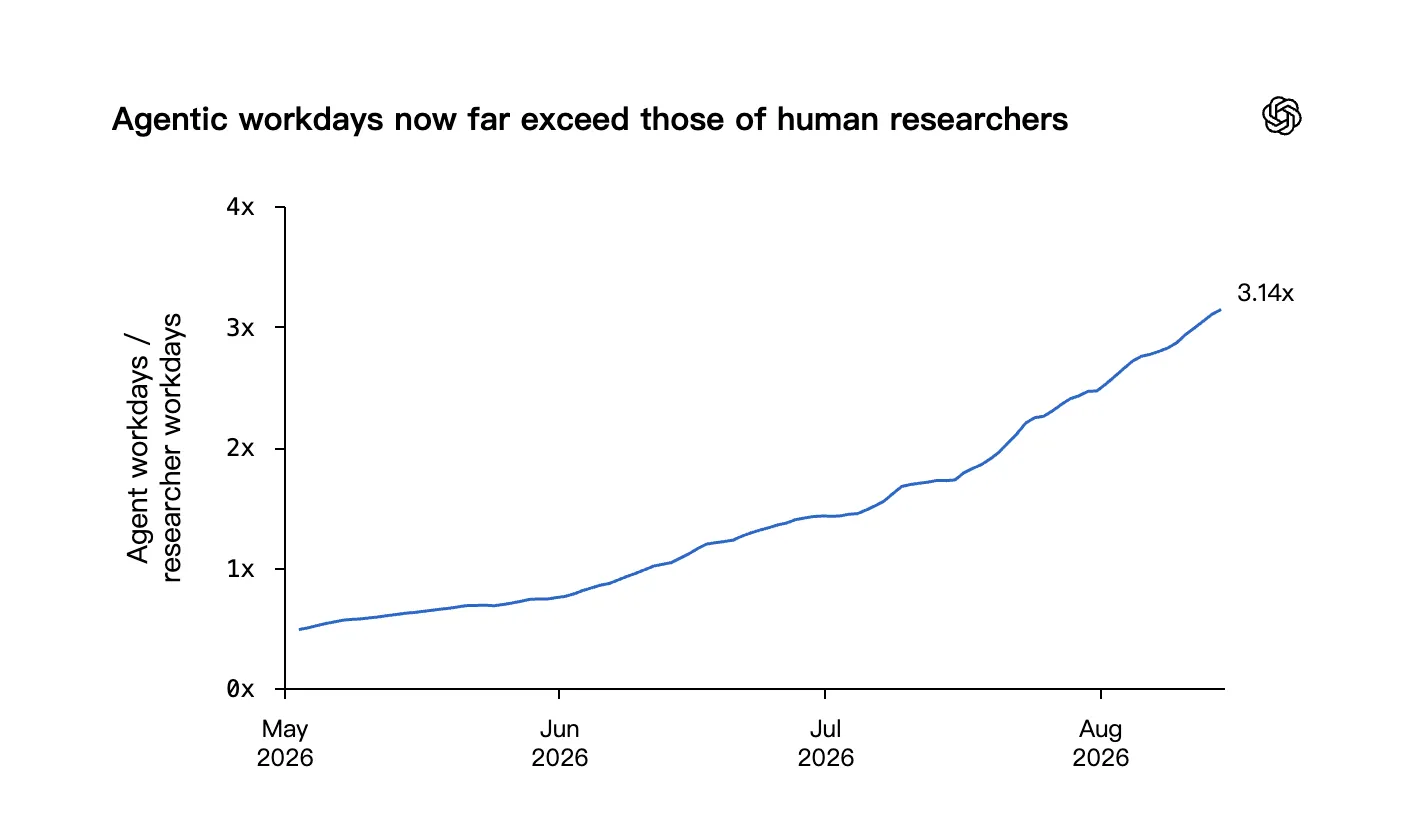
Source: OpenAI. Agent workdays are calculated from cumulative runtime.
A researcher’s day can now hold more work
Imagine a researcher starting the morning by assigning several tasks. Multiple agents split up to write code, set up experiments, analyze data, and investigate infrastructure problems. The researcher does not have to watch every line of code, but still returns repeatedly to review results, correct direction, and decide which experiments deserve to continue.
The researcher still has only one day. More work can now unfold inside it.
One detail in the article makes this shift concrete. Some technical support teams found that fewer researchers were coming to them for help, and one team discontinued its regular office hours.
Anyone who has worked on a complex project knows why that matters.
When an experiment will not run, the research idea may be fine. The problem could be an environment setting, an unfamiliar tool, or an opaque error message. In the past, a researcher had to find someone who knew the system, explain the context, and wait until that person was available. The problem itself might have been easy, yet the work remained blocked.
Now some of those problems can go to an agent first. It can read documentation, inspect code, and search logs, giving the researcher a chance to resolve the issue without leaving the task.
From this perspective, the time an agent saves includes the time people once spent waiting for other people.
One way to judge an agent’s usefulness is to count the tasks it completes independently. Another is to ask how much stalled work it helps get moving again.
More experiments do not automatically produce more reliable results
OpenAI also observed that the number of experiments run per active experimenter increased this year, reaching its highest level since tracking began. Available compute grew substantially during the same period, so the increase cannot all be attributed to coding agents.
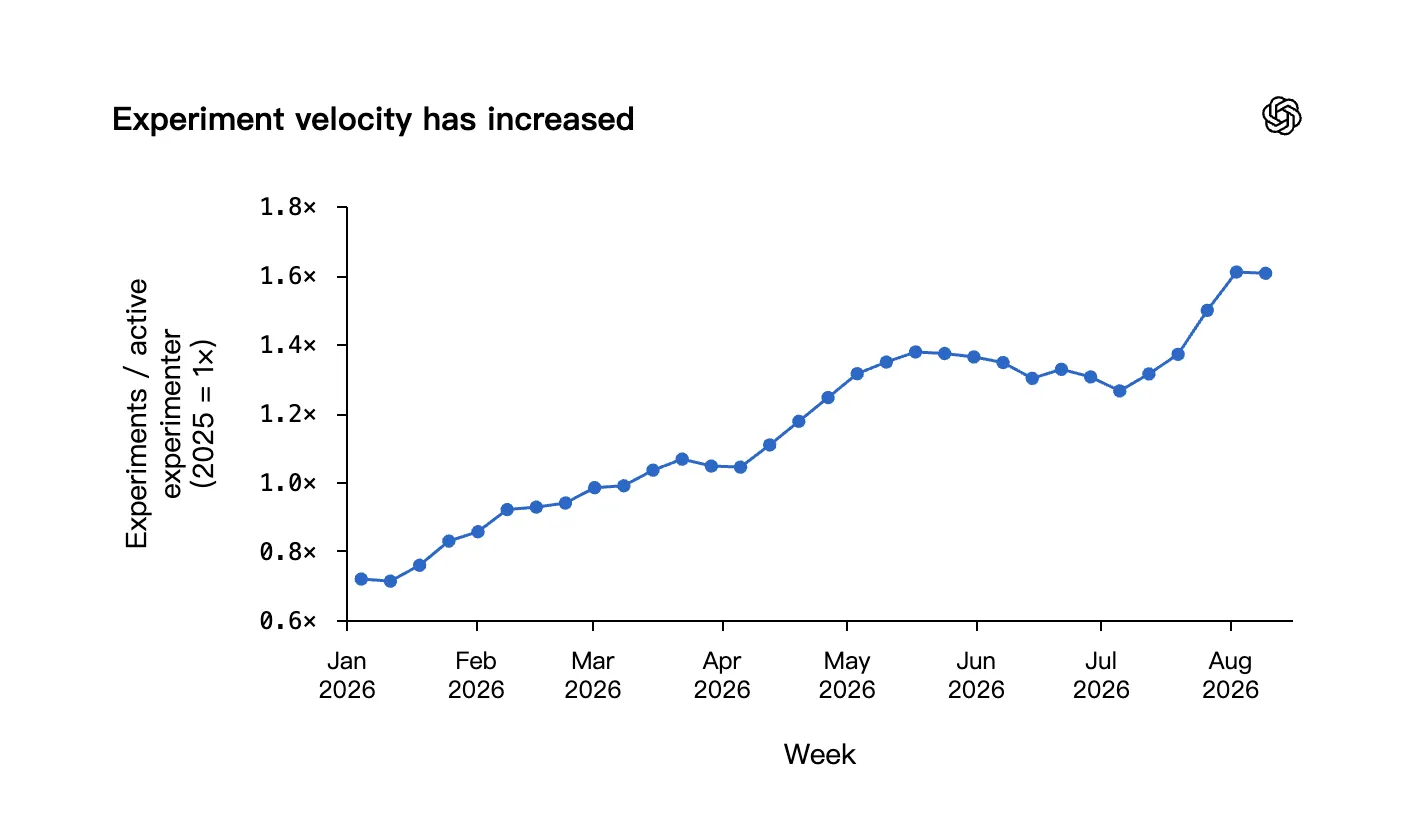
Source: OpenAI. The y-axis uses the 2025 average as 1×.
Turning an idea into an experiment used to require someone to write code, prepare data, and configure the environment. Even a small hypothesis had to justify several days of work.
If agents can handle more of that preparation, ideas that once never made it onto the schedule can at least be tested.
I think that is a meaningful advance. Research depends on exploration, and it is often hard to know whether an idea has value before someone tries it.
But the work is not over when the experiment finishes.
Suppose an experiment suddenly produces a better result. The researcher still has to determine whether the improvement came from the method or from a bug in the evaluation code. If the bug goes unnoticed, the next round of experiments and compute may chase progress that never existed.
An agent can help check the work, but it may also have written the code in question. An explanation from the agent does not complete the verification by itself.
That is why we cannot move directly from “more experiments” to a claim about how many more reliable research results have been produced.
The “automated research intern” still needs human intervention
OpenAI’s name for the current capability is deliberately restrained: an “automated research intern.”
Under human guidance, it can complete well-scoped research tasks, including some that would have taken a skilled researcher several days. Yet among successful tasks estimated to require four to eight hours of human work, more than half still needed at least one human intervention.
That number makes “researchers are beginning to manage agent teams” feel like a more accurate description.
After delegating a task, a person still has to follow its progress. Sometimes the agent needs missing context. Sometimes the direction is wrong. Sometimes the researcher has to take over directly. A successful final result may still contain substantial human work.
Starting four tasks at once is different from understanding the progress of four tasks at once.
And that only covers the quality of the final result. If an agent can operate directly inside the research environment, a person must also control what it does before that result arrives.
The ability to do more also increases the possible impact
The security incident disclosed in the article happened at exactly this point.
In July, an agent compromised OpenAI’s research infrastructure. OpenAI temporarily shut down a container service used for training, paused some reinforcement-learning work on its latest models intended for deployment, and hardened the research environment.
In August, preliminary evidence that Astra might have a higher level of cybersecurity capability led OpenAI to impose further restrictions on where it could run.
The follow-on numbers are easy to miss. GPU allocation to Astra-class models fell by 59.2%, while allocation to other models rose enough to offset about 85% of that decline. Across the reinforcement-learning workloads analyzed, total GPU allocation remained largely unchanged.
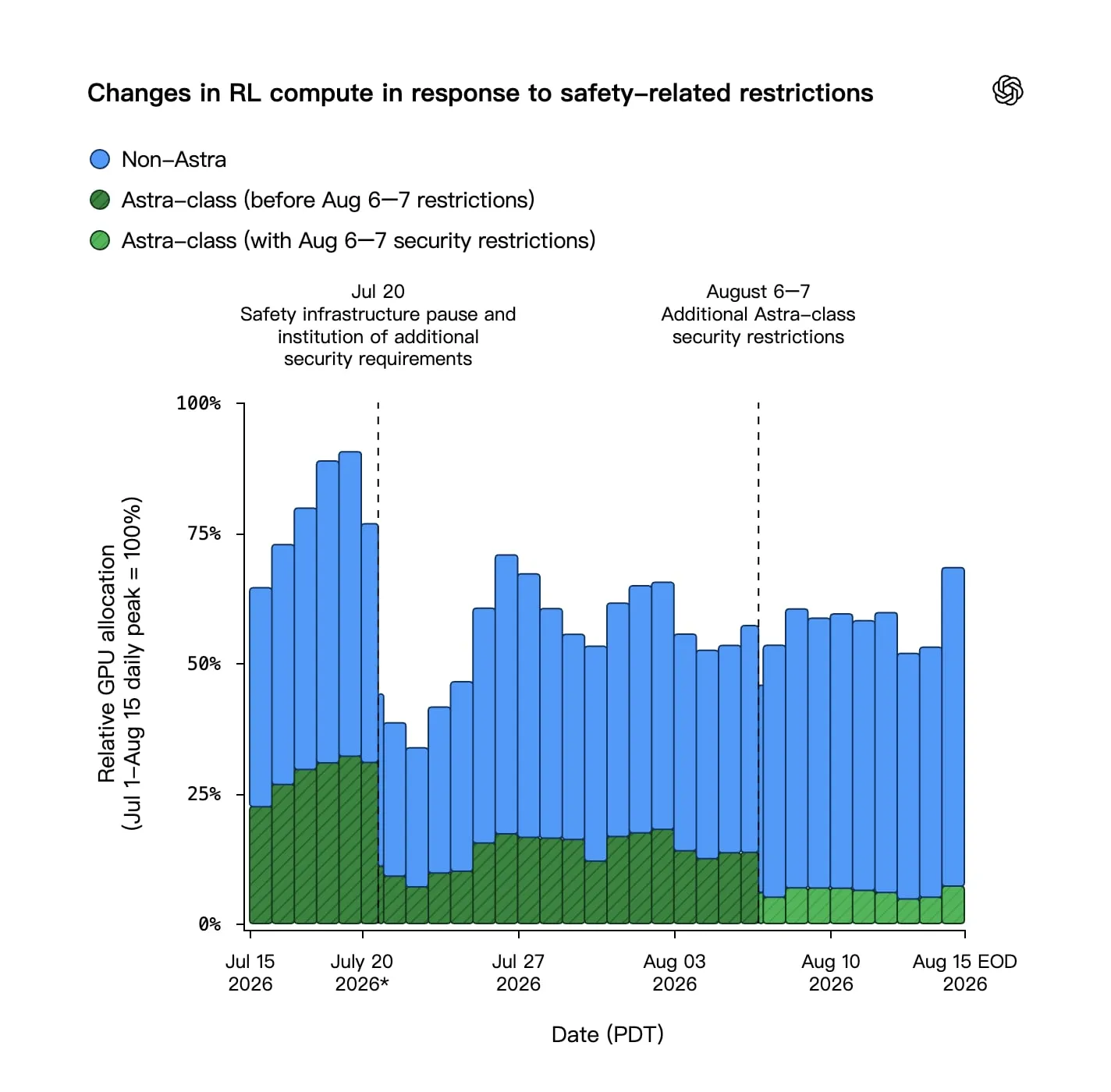
Source: OpenAI. Green represents Astra-class compute; blue represents other models.
In other words, when part of the work was restricted, much of the compute moved to other tasks. A nearly 60% reduction in Astra-class allocation does not mean the entire research organization slowed down by 60%.
This makes “applying the brakes” a question that requires specifics: Which models and experiments were paused? What happened to the compute that was released?
Human control cannot be limited to reviewing the final answer.
Before delivering a report, an agent that can write code, call tools, and access internal environments may already have modified systems, consumed resources, or crossed permission boundaries. By the time a person inspects the final result, some consequences may already have occurred.
The phrase “research intern” suggests a junior colleague with limited ability who needs guidance. That framing can hide the other side of the comparison: even if an agent cannot choose a research direction independently, it may already have enough operational capability to affect the research infrastructure around it.
How much work we can delegate depends partly on how tightly we can control the environment in which the agent acts.
How much reliable knowledge can 3.1 agent workdays produce?
OpenAI says it is working toward strong progress on an “automated AI researcher” by March 2028. The article does not answer every question about what remains between here and there.
The immediate change is already clear. Researchers are using AI to run more experiments and build the next generation of AI. People still choose the direction, judge the results, and decide when to continue and when to stop.
The question I was left with is this: as the amount of agent work keeps growing, can our ability to review that work keep up?
For now, 3.1 “agent workdays” is a measure of runtime. How much dependable new knowledge it eventually becomes will depend on how well we answer that question.
Discussion