
In the AI era, most people’s futures are up in the air.
This morning I came across a tweet from @python_xxt saying individuals need to be like loaches—constantly finding cracks, squirming through, staying flexible, carving out their own niche. He’s right. But I want to add something: squirming alone isn’t enough. You need to accumulate something with every step.
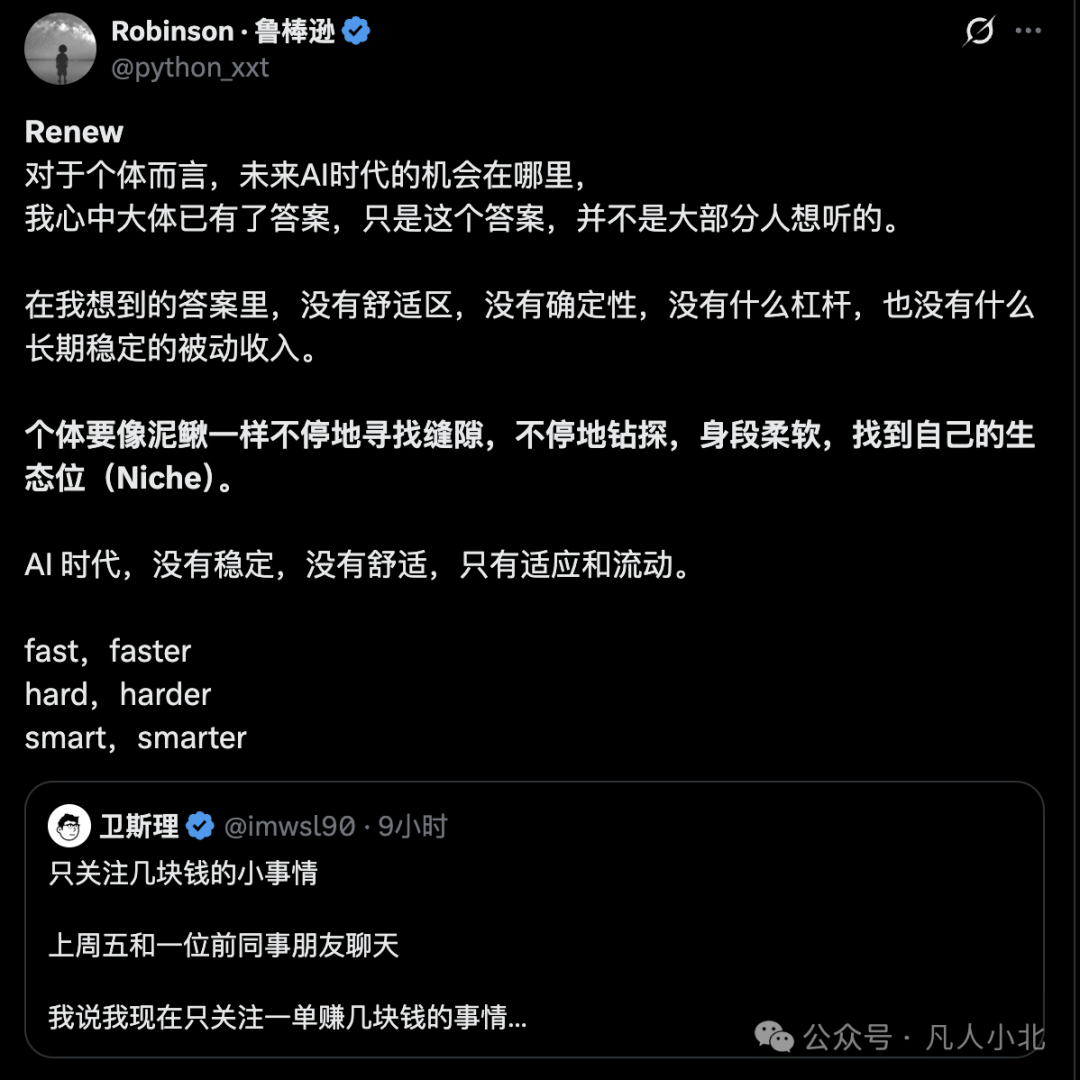
Let’s talk about how to squirm, where to squirm, and how to make it all worth your while.
1. About “No Comfort Zone, No Certainty”
This is already happening to many people. And it’s only going to get more obvious.
Jobs, skills, tools, platforms—they’re all going obsolete faster and faster. Today’s sense of security mostly comes from historical inertia. Once AI hits, everything reshuffles faster. Most people’s futures are genuinely up in the air.
A friend of mine was killing it as a content creator—follower growth was insane. Then the algorithm changed. Numbers got cut in half overnight. Freelancers? Platform rules change every three months. Tech folks? Tools rotate every six months. Product people? Direction gets overturned multiple times a year. Everyone says they want stability, but their actual lives are already unstable.
Here’s a common misunderstanding: Many people hear this and think, “Okay, so I just keep hustling, keep switching, keep chasing trends.” Result? Looks busy on the surface, but the trajectory is all over the place. No accumulation.
So when we talk about “no comfort zone, no certainty”—this isn’t a future prediction. It’s a description of reality. Most people just haven’t realized it yet.
If stability isn’t something you can count on, what can you count on? I’d say: having a sense of direction.
2. Speed Matters, But Direction Matters More
Don’t run in vain. “Faster / smarter”—these words sound exciting, but there’s something they don’t tell you: you need to know which direction you’re running in first. Otherwise, going faster just means hitting the wall sooner.
Here’s a common scenario. Someone spends a year learning a bunch of AI tools: Tried AIGC image generation, built some Agents, wrote some automation scripts.
Then you ask them: how much money did you make? Zero.
Is it because they didn’t try hard? No. Their effort was just scattered. Compare that to another type of person:
- Used AI to make PPTs for their boss, 300 yuan per job
- Later started selling templates, making a few thousand a month
- Then got into corporate training, tens of thousands per session
The starting point was unglamorous, but the path kept stacking upward. Speed is an accelerator. Wrong direction? Accelerating just gets you back to square one faster.
How do I judge if someone’s moving up? Three things: Are the problems they’re solving getting bigger? Are the responsibilities they’re carrying getting heavier? Is what they do being reused and trusted by more people?
Hit these three, and things will get smoother over time—even if short-term cash flow doesn’t look great.
3. Niche ≠ Obscure Skills. Niche = Unique Combination
Niches rarely look cool. Many people think finding a niche means hunting for some obscure skill nobody else knows.
In reality, the more stable path is combining several things you’re decent at (but not world-class in) into a position that’s hard to copy.
Many people focus on learning things nobody else knows. But here’s the thing: The work that nobody wants to do long-term? That’s often where the positions are.
I know a guy in medical software. Average technical skills. But he can take a doctor saying “this workflow feels off” and translate it into a requirements doc that engineers actually understand. Just that one thing makes him irreplaceable at his company.
Another case I saw: a ToB sales guy who didn’t know tech at all. Spent three months figuring out what AI can and can’t do. Now he does AI implementation consulting for clients. Tripled his rates.
See, real-world niches rarely look like “AI Expert” or anything fancy. More like “the tech person who actually gets the business” or “the one who can explain AI clearly AND sell it.” Doesn’t sound sexy on its own. But combined? Hard to replace.
4. About “Only Caring About Making a Few Bucks”
I get what that phrase means—“only caring about making a few bucks.” I read it as a phase correction. Very real.
Focusing on making a few bucks isn’t a bad thing. When someone goes from dreaming big to actually making some money, it means their brain is starting to work.
But over time, there’s a new problem: you’re so busy monetizing that you don’t accumulate anything.
Look at people who actually make it work. Take a designer:
- First, taking 100-yuan one-off gigs
- Then 500-yuan recurring clients
- Then 5000-yuan packages
- Only then talking about scale
People who start by talking about vision usually can’t even land the first gig.
But here’s where paths diverge: Some people make their few bucks and stop there. Others ask: Can this be easier next time? Can I reuse something? Can I sell it differently?
That’s where the roads split.
My own habit: after finishing something, I ask myself—if I do this again, which step can I skip? Even just jotting down two sentences of notes makes the next time faster.
So I lean toward a balanced state: have work that pays the bills, while quietly building stuff that compounds over time.
5. What Really Matters Is What You Leave Behind
Here’s something most people don’t realize: the gap isn’t in your skill list—it’s in what’s left after you finish the work.
Two people each take ten freelance gigs. One ends up with just ten payment records. The other ends up with a pricing template, three repeat clients, and a reusable workflow.
If what you leave behind is templates, SOPs, replicable methods—that’s skill. If what you leave behind is client trust, a reason for people to come find you—that’s your Niche.
So even if today’s income is mediocre, tomorrow there’s room to scale.
But if all you’re left with is exhaustion? Yeah, that’s a loss.
Bottom line: In this era, nobody’s going to hand you a straight path. But you can choose: step and forget, or lay a brick as you go. Whether the path works out? Short-term, it’s luck. Long-term, it’s how many bricks you’ve laid.
Lying flat won’t work. Grinding blindly won’t either. The people who end up winning are probably those who can hustle and accumulate at the same time.
That’s what I’m doing now: these past few days I’ve been making PPTs. I’ve organized all the company’s products and business lines into separate markdown files and PPT archives. When I make something new, I mix and match—reuse what works, tweak what needs tweaking. Way faster than starting from scratch.
Isn’t that a skill in itself? Nothing fancy. Just doing the small things consistently, and slowly building your own little knowledge base.
Skills determine what you can do. Niche determines who needs you. You need to build both.
What are you building right now?